

If you own a short-term rental or you’re thinking about buying one, there’s a tax strategy that can put tens of thousands of dollars back in your pocket in year one: cost segregation. It’s not a loophole. It’s not aggressive accounting. It’s a legitimate, IRS-recognized method for accelerating depreciation on the parts of your property that wear out faster than the building itself.
Here’s what it is, how it works for Airbnb and STR owners specifically, and why the timing right now (thanks to 100% bonus depreciation) makes this one of the most valuable tools in a real estate investor’s toolkit.
What Is Cost Segregation?
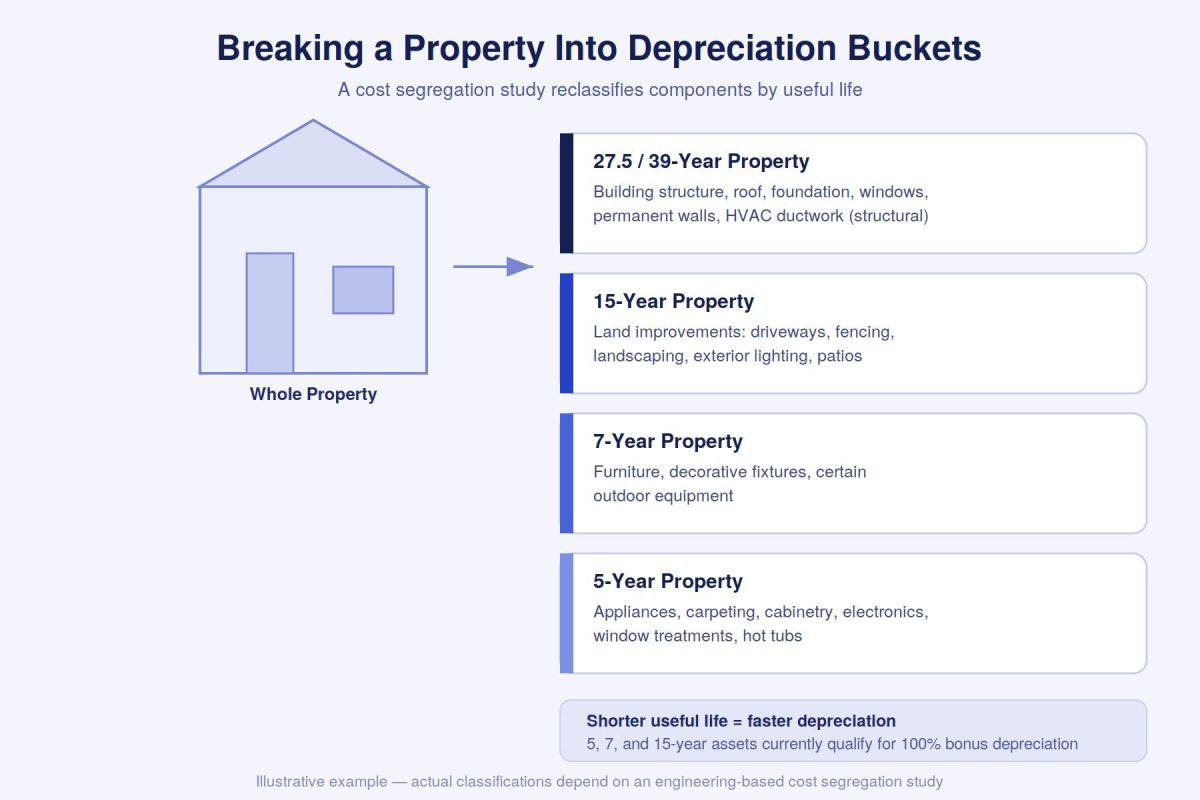
Cost segregation is an engineering-based tax study that breaks a property into its individual components and reclassifies many of them into shorter depreciation categories.
Without a cost segregation study, the IRS assumes your entire rental property depreciates evenly over 27.5 years (residential) or 39 years (commercial). But in reality, a property isn’t just one asset. It’s hundreds of assets bundled together: flooring, cabinetry, appliances, furniture, lighting, landscaping, fencing, and more. Many of these components have a much shorter useful life than the building shell itself.
A cost segregation study identifies which parts of your property qualify for 5-year, 7-year, or 15-year depreciation schedules instead of the standard 27.5 or 39 years. That reclassification is what unlocks accelerated, and in many cases immediate, deductions.
Why Cost Segregation Matters More for Short-Term Rentals Than Long-Term Rentals
STR owners are in a uniquely strong position to benefit from cost segregation, for two reasons.
First, furnished properties have more to segregate. Airbnbs and short-term rentals are typically sold turnkey and fully furnished: furniture, decor, kitchenware, electronics, outdoor living spaces, hot tubs, and more. All of that personal property and land improvement value can often be broken out and depreciated on an accelerated schedule, which means a larger share of the purchase price qualifies for faster write-offs compared to an unfurnished long-term rental.
Second, the STR loophole changes the tax treatment entirely. Under normal rental rules, rental losses are considered passive and can only offset passive income, not your W-2 or business income. But if your rental qualifies as a short-term rental under IRS rules (average guest stay of 7 days or less, in most cases) and you materially participate in operating it, your losses can be treated as non-passive. That means depreciation losses generated through a cost segregation study can directly offset active income, including wages.
This combination, more depreciable assets plus non-passive loss treatment, is why cost segregation has become one of the most talked-about strategies among Airbnb investors in the last few years.
How Bonus Depreciation Supercharges the Strategy
Cost segregation identifies which assets qualify for shorter depreciation schedules. Bonus depreciation determines how quickly you can deduct them.
Thanks to the One Big Beautiful Bill Act (OBBBA), signed into law in July 2025, 100% bonus depreciation was permanently restored for qualifying property acquired and placed in service after January 19, 2025. In practical terms, that means assets identified in a cost segregation study with a useful life of 20 years or less can potentially be deducted in full in the very first year, rather than spread out over 5, 7, or 15 years.
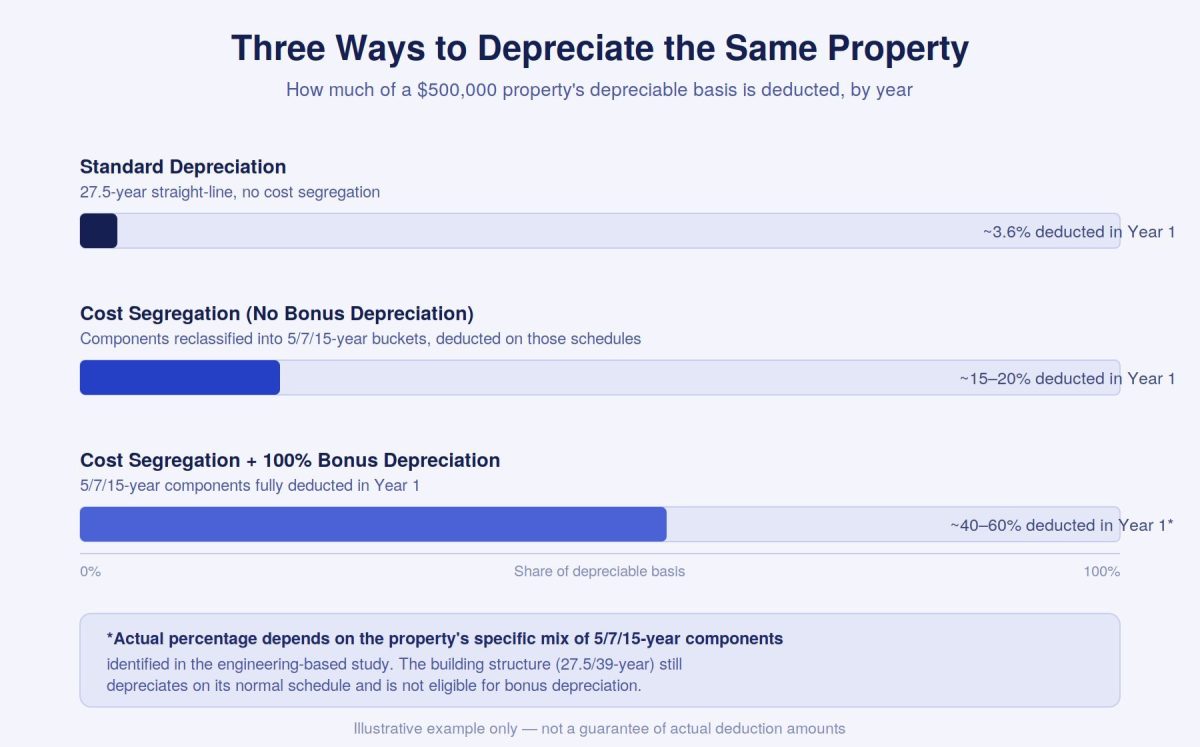
For an STR owner, this can translate into a first-year deduction covering a substantial percentage of the purchase price, all in the year the property is placed in service.
Who Should Consider a Cost Segregation Study
Cost segregation tends to make the most financial sense when several factors line up:
- Purchase price of $300,000 or more. Below this range, the study cost may outweigh the tax benefit.
- High-income earner. The more you pay in taxes, the more valuable it is to offset active income with accelerated losses.
- Materially participating in the property. To use STR losses against active income, you generally need to meet IRS material participation tests (commonly 100+ hours and more than anyone else involved).
- Plans to hold the property for several years. Selling too soon can trigger depreciation recapture, which claws back some of the tax benefit.
- Average stay under 7 days. This is what typically qualifies a rental as a short-term rental for tax purposes rather than a standard passive rental.
How the Process Works
- Property evaluation. A cost segregation firm or qualified engineer reviews the property, purchase price, and improvements.
- Engineering-based study. The property is broken down component by component. This is typically done by a specialized firm, not a general accountant, since it requires construction and engineering expertise to hold up under IRS scrutiny.
- Depreciation schedule reclassification. Components are sorted into 5-year, 7-year, 15-year, and 27.5/39-year buckets.
- Filing with your tax return. Your CPA applies the results, often using IRS Form 3115 if the study is done after the year of purchase, to claim the accelerated and bonus depreciation.
Studies are generally most valuable when completed in the same tax year the property is purchased and placed in service, but a “look-back” study can still capture missed value on properties bought in prior years.
A Word of Caution
Cost segregation is a legitimate strategy, but it’s not a DIY project and it’s not automatic.
- It requires a qualified study, not a rough estimate. The IRS has specific guidance on what makes a defensible study.
- Depreciation recapture applies when you sell. The deductions you take now generally get taxed back at sale, so this is a deferral and acceleration strategy, not a permanent tax elimination.
- Material participation rules are strict and need to be documented, especially if you’re using STR losses against W-2 income.
- Work with a CPA experienced in real estate and STR taxation before committing to a study, since the “STR loophole” only works when every requirement is met correctly.
Where This Strategy Meets Opportunity: Nashville’s STR Market
Because 100% bonus depreciation applies to qualifying property placed in service in the year of acquisition, timing your purchase matters. This is part of why Nashville has become a focal point for STR investors evaluating cost segregation and bonus depreciation strategies together.
Nashville’s short-term rental market is unusual in that new STR permits for non-owner-occupied properties are largely restricted to specific commercially zoned or hotel-permitted developments. That regulatory constraint limits new STR supply, which supports stronger occupancy and nightly rates for the properties that are compliant.
Three purpose-built Nashville developments, managed by GoodNight Stay in partnership with Alpha Residential, an in-house real estate team specializing in sourcing and structuring short-term rental investment properties, illustrate how the bonus depreciation timeline can be used strategically. Each becomes eligible for 100% bonus depreciation in a different year:
- Motif on Music Row, a hotel-permitted condominium eligible for 100% bonus depreciation in 2026.
- The Heritage, a historic downtown Nashville development on 2nd Avenue eligible for 100% bonus depreciation in 2027.
- Allegro Nashville, a purpose-built pre-construction STR development eligible for 100% bonus depreciation in 2028.

An investor evaluating a multi-property STR portfolio could, in theory, work with a team like Alpha Residential to structure acquisitions across all three developments and capture 100% bonus depreciation deduction three consecutive years in a row, pairing cost segregation studies with each purchase to maximize the accelerated write-off. That’s a tax structure that’s difficult to replicate outside of a market with staggered, purpose-built STR inventory like this one.
For further details on each development, read the breakdown of Nashville’s best short-term rental investment properties.
The Bottom Line
Cost segregation isn’t a niche accounting trick. For short-term rental owners, it’s one of the clearest ways to turn a real estate purchase into an immediate tax advantage, especially when paired with 100% bonus depreciation and the STR loophole’s non-passive loss treatment. Whether you already own a property or you’re evaluating your first STR purchase, talk to a CPA who specializes in short-term rental taxation before you close to make sure you capture the full benefit.
If you’re interested in learning more about these three Nashville STR opportunities, or simply curious where to start with owning a short-term rental property, contact Alpha Residential today.
This blog is for informational purposes only and is not tax or financial advice. Consult a licensed CPA or tax professional to evaluate your specific situation before making investment or tax decisions.
